
Housework Schedule Template
Most housework arguments are about fairness: who did what, and how much time it took. This template maker turns your list of chores and how long they take into a balanced weekly schedule, sharing the minutes evenly among the people in your home — or weighted for children and busy weeks. Print it for the fridge or download it for a spreadsheet.
- Free to use
- No sign-up
- Runs in your browser
Housework schedule maker
Chores
One per line: chore | frequency (daily, weekly, 2x week, fortnightly, monthly) | minutes
Housework Planner Pack
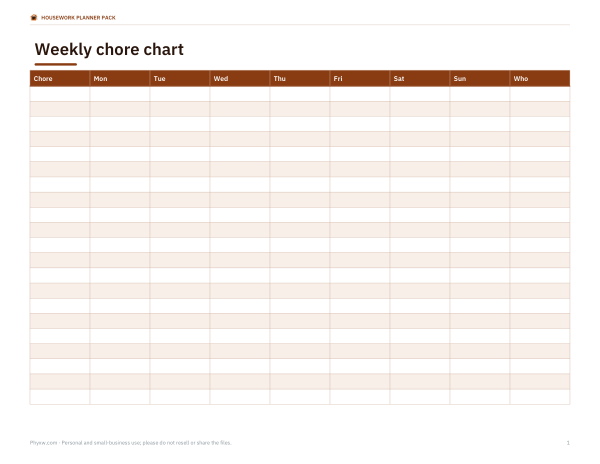
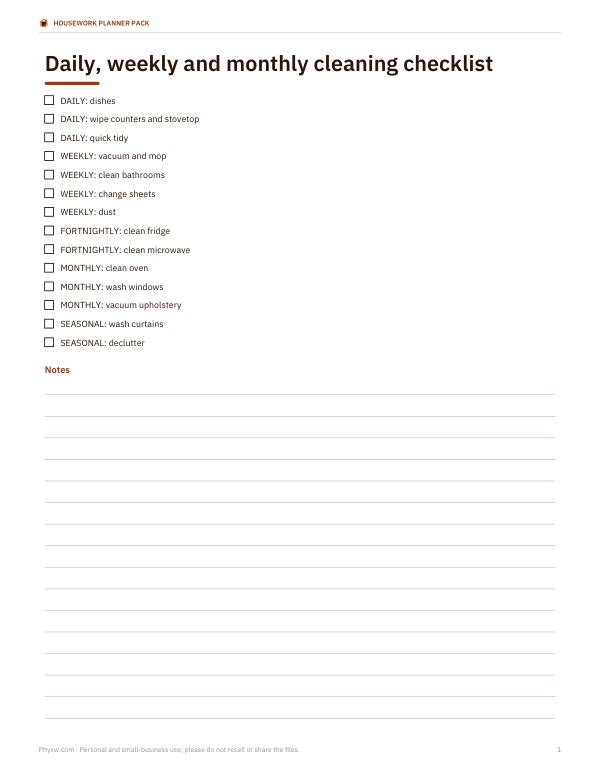
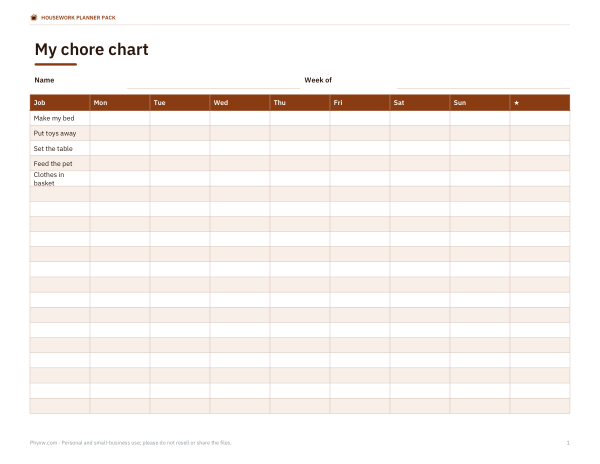
Printable housework planners: weekly chore chart, daily/weekly/monthly cleaning checklists, a kids’ chore chart and an editable Excel rota with minute totals per person.
- Weekly chore chart (PDF/DOCX)
- Cleaning checklist (PDF/DOCX)
- Kids’ chore chart (PDF)
- Excel rota (XLSX)
Formats: PDF, DOCX, XLSX. Instant download after payment (link valid 72 hours, up to 5 downloads). AI-assisted: the templates were drafted with AI help and reviewed and laid out before publishing.
$5.00 USD, one-time 4 files · about $1.25 each
- Instant download
- 7-day refund
- Secure checkout by Stripe
7-day money-back guarantee. Full refund within 7 days of purchase, even after you download.
Free sample: Cleaning Checklist (PDF, 57 KB)
Full refund within 7 days — see the refund policy and license.
Free printables
Single sheets you can print right now, no sign-up. The full pack adds every sheet in one download plus the editable files.
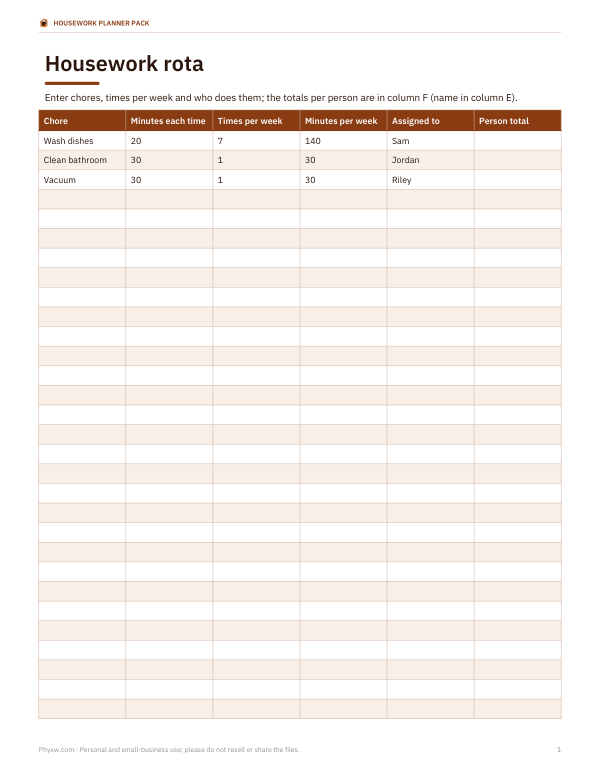 Printable Housework Rota Sheet
How the schedule is built
- Each chore is placed on the days its frequency needs: daily chores on all seven days, twice-weekly chores on two days three days apart, and weekly, fortnightly and monthly chores on one day of the week.
- Tasks are then assigned longest first to whoever currently has the fewest minutes relative to their share.
- A lighter share (for example Riley*0.5 for a child) means that person is given about half the minutes of a full share.
- Press Reassign to shuffle which day weekly chores fall on and who does them, while keeping the minutes balanced.
Balancing by minutes rather than by number of chores is fairer: “take out the rubbish” and “clean the bathroom” are both one chore but take very different amounts of time.
Estimating how long chores take
| Chore | Typical time | Notes |
|---|---|---|
| Wash dishes / load dishwasher | 15–30 min a day | Depends on cooking and household size |
| Wipe kitchen counters | 5 min | After cooking |
| Vacuum a living area | 20–40 min | Longer with pets |
| Clean a bathroom | 20–45 min | Toilet, sink, shower, mirror, floor |
| Change bed sheets | 10–20 min per bed | Plus laundry time |
| A load of laundry | 20–40 min of hands-on time | Sorting, loading, hanging, folding |
| Grocery shopping | 45–90 min | Including travel |
| Clean the fridge | 20–30 min | Monthly or fortnightly |
| Clean the oven | 30–60 min | Every few months for many households |
Time yourself for a week to get realistic numbers for your home; guesses are usually too low for jobs people dislike and too high for jobs they enjoy.
Worked example
Sam, Jordan and Riley (a teenager with a half share) enter the default list of 14 chores. Daily dishes (20 minutes × 7) and counters (5 × 7) make up a big block, twice-weekly laundry adds an hour, and the weekly jobs add about three hours. The tool totals 8 hours 50 minutes of housework in the week (counting the fortnightly and monthly jobs in full) and gives Sam about 210 minutes, Jordan about 215 and Riley about 105 — roughly twice the minutes for a full share as for the half share. Because chores can’t be split, the totals are close but rarely identical. If Riley complains that bathroom duty always lands on them, pressing Reassign shuffles the days and assignments while keeping the balance.
Daily, weekly and monthly checklist
| How often | Typical chores |
|---|---|
| Daily | Dishes, wipe counters and stovetop, quick tidy, make beds, sort mail |
| Two or three times a week | Laundry, take out rubbish and recycling, water plants, quick bathroom wipe |
| Weekly | Vacuum and mop floors, clean bathrooms, change sheets, dust, grocery shop, clean mirrors |
| Fortnightly | Clean the fridge, wash bath mats, clean the microwave |
| Monthly | Clean the oven, wash windows, vacuum upholstery, clean light fittings, descale kettle |
| Seasonally | Wash curtains, clean gutters, deep-clean carpets, declutter wardrobes |
Making a rota stick
- Agree the list and the time estimates together before assigning anything — people accept a schedule they helped build.
- Post it where everyone sees it, such as the fridge or a shared phone note.
- Define “done”: a clean bathroom means the same thing to everyone only if you list what’s included.
- Allow swaps, but record them so the balance stays fair.
- Review it monthly; adjust times and shares as schedules change.
- Consider rotating unpopular chores weekly rather than assigning them permanently.
Fortnightly and monthly chores
The schedule shows one week. Fortnightly chores are marked “alt. weeks” and monthly chores “1st week”, and their minutes are counted in full in that week, so the week containing them is the heaviest. If you prefer an even load every week, divide their minutes (a 45-minute monthly oven clean becomes about 11 minutes a week) and enter them as weekly chores, or give them to the person with the lightest week and rotate.
Chores for children by age
| Age | Suitable chores (with supervision as needed) |
|---|---|
| 2–3 | Put toys in a box, put clothes in the laundry basket |
| 4–5 | Set the table, feed pets with help, match socks |
| 6–8 | Make their bed, sort laundry, water plants, help put away groceries |
| 9–12 | Load the dishwasher, vacuum, take out rubbish, simple cooking |
| 13+ | Laundry start to finish, clean the bathroom, cook simple meals, mow the lawn |
Use the share multiplier (for example *0.3 for a six-year-old) so younger children get fewer minutes, and pick chores that suit their age.
Why balance by time
Surveys in many countries find that unpaid housework is often shared unevenly within households, and much of that imbalance is invisible because it is spread across many small tasks. Writing chores down with realistic times makes the total visible, which makes it easier to talk about and share. Remember the “mental load” too — planning meals, noticing what needs doing and booking repairs take time even if they are not on the list; add them as chores if they matter in your home.
Privacy
Names and chores stay in your browser. Nothing is uploaded or saved unless you download the CSV or print the schedule.
Frequently asked questions
How do I make a housework schedule?
List chores with frequency and time, list the people sharing them, and divide the minutes fairly across the week.
How much housework is normal per week?
It varies widely by home size and household; many households spend several hours a week on routine chores.
How do I split chores fairly?
Balance by time rather than number of chores, and agree the time estimates together.
Can children have a smaller share?
Yes — add *0.5 (or another fraction) after a name to give a lighter share.
Can I open the schedule in Excel?
Yes, download the CSV and open it in Excel or Google Sheets.
Is my data saved?
No. It stays in your browser until you close the page.